Blog

  • Common Problems Associated with Teeth and Gums

    Is it serious, or can it wait? That’s what most people ask when they notice bleeding gums, a sensitive tooth, or breath that won’t go away no matter how much they brush.

    Most common problems associated with teeth and gums start small. A cavity that is painless or gum disease that begins as a little bleeding. By the time there’s real pain, the easy fix treatment window is gone.

    Elite Dental Studio an ISO certified dental chain, each problem from early cavities to advanced gum disease is handled by a specialist dentist. Periodontists, restorative specialists, endodontists, and oral surgeons are available on site every day, so no referrals are made to outside clinics.

    What Are the Most Common Teeth Problems That People Experience?

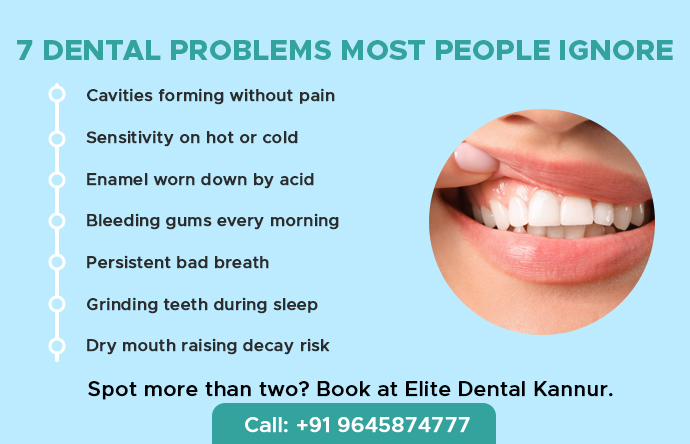
    There are four most common teeth problems including cavities, sensitivity, erosion, and dental abscess. Most of these start without any pain and thus people miss them.

    A cavity doesn’t hurt at first, because bacteria feed on sugar and produce acid. That acid eats through the enamel, the outer layer of the tooth, slowly and silently.

    By the time you feel it, the cavity has already gone deeper into the pulp where the nerve sits. That’s when a filling turns into a root canal.

    • Tooth Sensitivity 

    Cold water or sweet food triggers a sharp zing. It fades in a second, so most people assume it’s normal. It isn’t.

    Sensitivity means the protective outer layer of the tooth has thinned. Underneath that layer are tiny channels that lead straight to the nerve. When enamel wears away, temperature and sugar travel down those channels and the nerve responds.

    It usually means enamel wear, an early cavity, or receding gums.

    • Tooth Erosion

    Erosion looks like decay but comes from a completely different place. Bacteria cause decay. Acid causes erosion. Fizzy drinks, citrus fruit, and stomach acid from reflux are the main sources.

    The surface of the tooth dissolves gradually. Teeth start looking yellower because the darker layer underneath begins to show through. Edges get thinner. Chips happen more easily.

    An abscess is a pocket of infection. Throbbing pain, swelling around the jaw or face, a bad taste in the mouth, sometimes a fever. This is the problem that can’t wait.

    What Are the Most Common Gum Problems and How Do They Progress?

    Gum problems follow a clear path: plaque builds up, the gums get inflamed, infection sets in, then bone starts to go. Each stage is harder to reverse than the one before it.

    • Gingivitis

    Gums that look a bit red or bleeding when you brush. Most people think they must have brushed too hard. But that’s not always true. That’s gingivitis.

    The gums are reacting to bacteria in the plaque sitting at the gumline. The good news: at this stage, it’s completely reversible. A professional clean removes the plaque and tartar causing it.

    • Periodontitis

    This is what gingivitis becomes when nobody deals with it. The infection moves below the gumline. It starts breaking down the bone and tissue that hold the teeth in place. Periodontitis is also linked to heart disease, diabetes complications, and pregnancy risks. The bacteria enter the bloodstream through infected gum tissue. This is the outcome of ignoring bleeding gums long enough.

    • Gum Recession

    Gum recession happens slowly, from gum disease, brushing too hard with a firm brush, or genetics. Most people notice it when the sensitivity starts. The gums pull back from the teeth, exposing the roots.

    Roots have no enamel protecting them. They’re sensitive, they decay more easily, and teeth start to look longer than they used to.
    7-dental-problems-most-people-ignore

    What Other Dental Problems Are Associated with Teeth and Gums?

    Teeth grinding, bad breath and dry mouth are the m,ost common 3 conditions that affect a lot of people, often for years, without anyone connecting them to a dental cause.

    • Bad Breath (Halitosis)

    Mouthwash helps for an hour. Then the bad breath is back. It doesn’t fix the source.

    Bad breath comes from two places. The first is bacteria on the tongue and between teeth breaking down food. The second is active gum disease, where infected tissue produces a constant smell.

    • Bruxism (Teeth Grinding)

    Most people who grind their teeth at night don’t know they do it. They find out when a dentist notices the wear patterns: flat biting edges, small chips, enamel worn thin where grinding happens.

    By then, months of enamel are already gone. Enamel doesn’t come back.

    • Dry Mouth (Xerostomia)

    Saliva does more than keep the mouth comfortable. It neutralises acid, clears food particles, and delivers minerals that protect enamel. Without enough of it, teeth and gums become much more vulnerable to decay and infection.

    The most common cause is medication. Antihistamines, antidepressants, and blood pressure drugs are the usual culprits.

    Which Symptoms of Teeth and Gum Problems Should You Never Ignore?

    Six signs that mean a visit to the best dental clinic in Kannur this week, are:

    • Swelling around a tooth or jaw
    • Gums that bleed every time you brush
    • Pain when biting
    • A tooth that feels loose
    • Sensitivity that lingers after the trigger is gone
    • Visible pus or a bump on the gum

    Go in within 48 hours. Most people with serious dental problems say the same thing when they finally come in: they noticed something weeks ago and waited. The condition that was a filling then is a root canal now.

    How Can You Prevent Common Teeth and Gum Problems Before They Start?

    Most common teeth and gum problems are preventable with just 4 habits, done consistently, before they need treatment. These are:

    • Brush twice a day with fluoride toothpaste. Two minutes each time.
    • Floss every day. One minute of flossing removes the plaque that causes most gum problems.
    • Cut down how often you have sugar or fizzy drinks. Frequency matters more than quantity.
    • Get a professional clean every six months. A clean catches early decay before it needs anything more than a small filling.

    Book Your Appointment at Elite Dental Studio Kannur

    If any of these dental problems sounds familiar, earlier is better. A cavity caught today is a 20-minute filling. The same cavity in three months may need a root canal.

    At Elite Dental Studio, a dental clinic in Kannur uses an intraoral camera that shows you exactly what the dentist sees, on screen, in real time. Dr. Akash K Babu, MDS Periodontics and Laser Specialist, handles gum disease cases using BioLase laser treatment, providing less discomfort, faster healing, and no scalpel for most soft tissue procedures. In-house OPG digital radiography means full-mouth X-rays are also done on the same visit.

    Since 2020, Elite Dental Studio has treated over 100,000 patients across Calicut, Kochi, Kannur, and Coimbatore. To get a full clinical examination done call: +91 9645874777

    Frequently Asked Questions

    What causes gums to bleed every time I brush my teeth?

    Bleeding gums are the first sign of gingivitis, an inflammation caused by plaque at the gumline. It’s not from brushing too hard. At this stage it’s fully reversible. Left alone, it progresses to periodontitis, where the bone loss is permanent.

    Is tooth sensitivity always a sign of a serious dental problem?

    Tooth sensitivity is always a signal. Brief sensitivity on cold or sweet food usually points to enamel wear or an early cavity. That needs a clinical check.

    Can early-stage gum disease be reversed without treatment?

    Gingivitis is fully reversible with a professional clean up and home care. But periodontitis, where bone loss has started, is not reversible. The Treatment can only stop the further damage .

    How do I know if I have a dental abscess or just a toothache?

    A toothache is pain in a tooth. An abscess involves infection: throbbing pain, visible swelling of the face or gum, fever, foul taste. If two or more of those are present alongside the pain, go in within 48 hours.

    How often should I visit the dentist if my teeth feel fine?

    Every six months. Cavities and early gum disease are both painless at the start. By the time something hurts, what was a simple fix is usually a significant one.
  • Your Complete Guide to Invisalign: Everything You Need to Know

    You want straighter teeth, but just don’t want metal in your mouth for two years. Invisalign fixes that. Clear trays, no wires, removable for meals. Most people around you won’t notice you’re wearing anything.

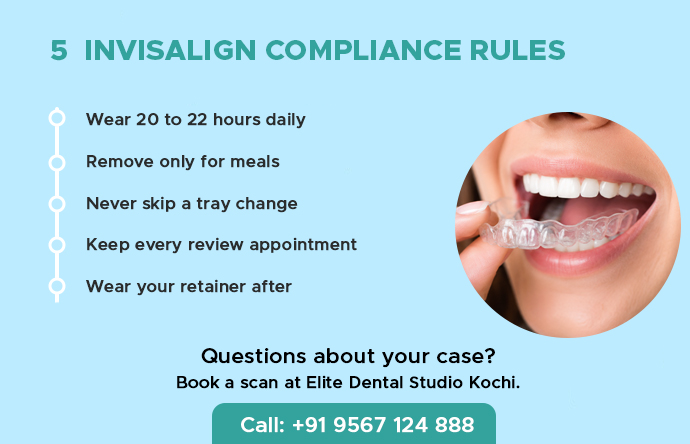
    But the Invisalign trays only work if you wear them 20 to 22 hours a day. Every day. The treatment is planned by the orthodontist. The results are decided by you.

    At Elite Dental Studio in Kochi, certified Invisalign orthodontists handle every case since 2020: Dr. Nafeesa Shaduly, Dr. Vidhu S, and Dr. Rohit S Ramdas, alongside aligner specialist Dr. Manu Mathew. Our dental clinic is ISO certified and has managed more than 100,000 patients .

    The complete guide to Invisalign covers what the process looks like from scan to final tray, who qualifies, what it costs in Kochi, and exactly what you need to do for the results to hold.

    What Is Invisalign and How Does It Move Teeth?

    Invisalign is a series of clear, removable trays, called aligners, that shift teeth gradually into the position your orthodontist has planned. Each tray is slightly different from the last. You wear one for one to two weeks, then move to the next.

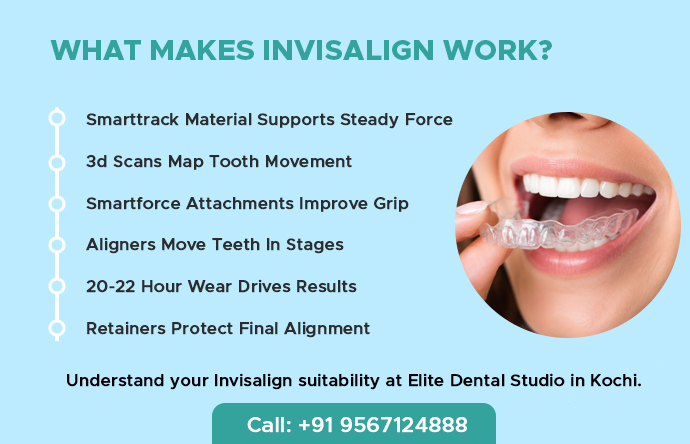
    By the final tray, your teeth sit where the plan said they would. The trays work through controlled pressure. Small tooth-coloured dots called attachments are bonded to certain teeth before treatment starts. They give the tray grip and help it apply force in the right direction. You’ll barely notice them.

    Who Is a Good Candidate for Invisalign Treatment?

    Invisalign works well for a wide range of cases. Yet, it doesn’t work for all of them. Cases Invisalign handles well:

    • Mild to moderate crowding
    • Small to medium gaps between teeth
    • Overbite where the top teeth sit too far over the bottom ones
    • Underbite where the bottom teeth sit in front
    • Crossbite where teeth bite down on the wrong side
    • An open bite where front teeth don’t meet when the mouth closes.

    Cases where fixed braces work better:

    • Severe crowding
    • Large skeletal discrepancies between the upper and lower jaw
    • Cases where teeth need to be rotated or moved vertically

    The only way to know if your case qualifies is a clinical scan. An orthodontist checks from an X-ray and a 3D mouth map whether Invisalign suits your case.

    What Does the Invisalign Process Look Like Step by Step?

    Invisalign treatment runs in six stages: consultation, 3D scan, digital simulation, tray fitting, progress reviews every six to eight weeks, and a retainer phase after the final tray.

    • Step 1: Consultation : The orthodontist examines your teeth, bite, and jaw.
    • Step 2: iTero Digital Scan : An iTero scanner is a small handheld camera that maps your teeth in 3D. It captures a full model of your mouth in a few minutes.
    • Step 3: ClinCheck Simulation : The scan goes into ClinCheck software, which maps every planned tooth movement from start to finish. You see what your teeth will look like at the end before any tray is made.
    • Step 4: Tray Fitting : The orthodontist bonds attachments to the relevant teeth and fits the first tray and it takes under an hour.
    • Step 5: Progress Reviews:  You come in every six to eight weeks. The orthodontist checks movement, hands over the next set of trays, and confirms the case is tracking to plan.
    • Step 6: Retainer Phase:  When the final tray comes off, teeth haven’t finished settling. A retainer, the custom-fitted device that holds teeth in their new position, is worn full-time for the first few months, to prevent teeth from drifting back.

    5-invisalign-compliance

    How Long Does Invisalign Treatment Take?

    Most invisalign treatment cases in India run between 12 and 18 months. Mild cases finish in 6 to 12 months. Complex corrections take 18 to 24 months.

    The ClinCheck stage sets your timeline before treatment starts. You’ll know your estimated duration before you commit to anything.

    One variable that can extend any timeline regardless of case complexity is compliance. Hence, the treatment plan is fixed. How long it actually takes is up to the patient.

    What Does Invisalign Treatment Cost in Kochi?

    Invisalign treatment cost in India typically ranges from Rs. 1.5 lakh to Rs. 4 lakh depending on case complexity, the number of trays required, and the clinic.

    In Kochi, expect pricing in line with that range, with simpler cases sitting at the lower end and full-arch complex corrections at the upper end.

    What’s usually included: 

    • The full aligner series
    • ClinCheck planning
    • Progress reviews
    • And attachments.

    What’s sometimes excluded:

    • Retainers after treatment
    • Any restorative work needed before aligners start
    • And replacement trays for lost or damaged aligners.

    Two patients with the same visible problem can have different costs. The clinic confirms the exact figure after the ClinCheck simulation.

    Is Invisalign the Right Choice or Are There Better Options?

    Clear aligners aren’t the right fit for every case. If your case is mild to moderate and you’ll wear the trays consistently, Invisalign gives you the result with the least disruption to daily life. If your case is complex or you know compliance will be a challenge, fixed braces may give a more predictable result.

    Here’s the honest comparison:

    Invisalign Ceramic Braces Metal Braces
    Visibility Nearly invisible Tooth-colored, low profile Visible
    Removability Yes No No
    Best for Mild to moderate cases Mild to moderate All severities
    Compliance required High None None
    Cleaning Easy Slightly harder Harder

    Book Your Invisalign Consultation at Elite Dental Studio Kochi

    The first step is a scan and a conversation. No commitment, no cost until you’ve seen your ClinCheck simulation and agreed to the plan.

    You’ve read the full picture. The only thing left is seeing what it looks like for your specific teeth. The orthodontist for Invisalign treatment near me at Elite Dental Studio scans your teeth in 3D, plans your case in ClinCheck, and shows you your projected result on screen before any cost is committed.

    Elite Dental Studio is an ISO certified dental chain, rated consistently across Google for professional care and transparent treatment planning. Every Invisalign treatment in Kochi case is planned and reviewed by a certified Invisalign orthodontist and a dedicated team. Walk in or call ahead to book a consultation: +91 9567 124 888

    Frequently Asked Questions

    Is Invisalign painful?

    Mild pressure for the first day or two after switching to a new tray is normal. That’s the teeth responding to movement. It fades quickly and is far less discomfort than metal wire tightening.

    Can I eat and drink with Invisalign trays in?

    Remove the trays for all food and drinks except plain water. Hot drinks warp the tray. Food gets trapped underneath and causes decay. Back in immediately after eating.

    Will people notice I’m wearing aligners?

    Most won’t. The trays are clear and sit flush against the teeth. Attachments are tooth-coloured. In a normal conversation, they’re not visible.

    What happens if I lose an aligner tray?

    Contact the clinic immediately. The orthodontist will advise whether to go back to the previous tray, move to the next one, or order a replacement. Don’t leave a gap in treatment.

    Do I need a retainer forever after Invisalign?

    Nighttime retainer wear is usually long-term, often indefinite. The bone and tissue around each tooth hold it in position, and both continue to remodel slowly for years. The retainer is what keeps the result permanent.

  • Invisalign Clear Aligners At Elite Dental Studio Kochi: Benefits, Process & Cost

    If you want straighter teeth but feel unsure about metal braces, Invisalign can feel like the cleaner and more comfortable choice. You may worry about visibility during meetings, food limits, speech changes or the final price. Invisalign in Kochi helps solve these concerns with clear removable aligners that move teeth through planned digital steps. At Elite Dental Studio, we support your smile journey with an in-house iTero scanner, certified Invisalign provider support and an orthodontist with 8+ years of aligner experience.

    We also offer evening appointments until 8 PM for working professionals in Kochi. This guide is written by an expert orthodontist from Elite Dental Studio to explain the benefits, process and cost with clear facts.

    Read on to see whether Invisalign suits your smile, lifestyle and budget before you book your scan consultation with confidence and understand how clear aligners can fit your daily routine well today too easily.

    Why Invisalign Leads The Clear Aligner Category?

    • Invisalign leads the clear aligner category because it combines advanced material, precise digital planning and global treatment data.
    • Its SmartTrack material is around 30% more elastic than generic aligner plastic. This helps the tray fit better and maintain steady force.
    • Many generic aligners lose nearly 40% pressure after 10 days. Invisalign keeps more consistent pressure across the usual 2-week wear cycle.
    • That steady pressure matters because straightening teeth needs controlled movement, not sudden force.
    • Invisalign also uses SmartForce attachment designs. These help guide tooth movement more precisely in selected cases.

    With over 14 million treated cases globally, Invisalign brings clinical data that supports more predictable clear aligners. This makes Invisalign in Kochi a strong option when you want discreet, comfortable treatment instead of traditional braces.

    5 Benefits Of Invisalign Clear Aligners

    Invisalign helps you straighten your teeth with a discreet look, better comfort, easier cleaning, fewer food restrictions and a treatment routine that fits daily life.

    1. Near-Invisible Look For Work And Social Life

    Invisalign trays stay almost unnoticeable in normal lighting beyond 1.5 feet.

    This helps when you attend meetings, interviews, college classes or video calls. You can speak, smile and interact without worrying about metal brackets showing in photos.

    If you are looking for clear dental aligners kochi because you want a subtle option, Invisalign gives you that advantage without changing your routine.

    2. Comfortable Fit Without Wires Or Brackets

    Invisalign uses smooth, custom-made plastic trays.

    There are no wires that poke your cheeks and no brackets that rub against your lips. Most people adjust to the trays within 48 hours.

    Around 95% of patients do not notice lisping after day 3, which makes it easier to continue work and daily conversations.

    3. Easier Eating Without Food Restrictions

    You remove Invisalign before eating. Fixed braces often need you to avoid 30+ foods. Flossing with threaders can take 8 to 10 minutes.

    With invisaligners, you do not need to avoid sticky, hard or crunchy foods the way you often do with braces. You can eat normally, then brush and wear your trays again.

    This is one of the most practical Benefits of Invisalign in Kochi for busy students, professionals and people who eat outside often.

    4. Better Brushing And Flossing Every Day

    Invisalign makes oral hygiene easier because you remove the trays before cleaning your teeth.

    With braces, flossing can take 8 to 10 minutes with threaders. With Invisalign, you brush and floss normally.

    This helps reduce plaque buildup, gum irritation and food trapping during treatment.

    5. Digital Planning For Predictable Smile Correction

    Invisalign treatment uses advanced imaging and 3D scanning to plan tooth movement before you start.

    The scan helps your dentist check your bite, tooth position and expected smile changes. This gives you a clearer idea of the treatment path before the first aligner arrives.

    Invisalign adds about 2 minutes around meals when you follow the remove, eat, brush and reinsert routine. These practical Benefits of Invisalign in Kochi matter for students, professionals and busy parents.

    Your Invisalign Journey At Elite Dental Studio Kochi

    Your Invisalign journey at Elite Dental Studio Kochi starts with a scan, moves into digital planning and continues with regular progress checks.

    • Consultation takes around 45 minutes.
    • Digital photos and X-rays guide assessment.
    • iTero scan takes about 12 minutes.
    • Both arches get scanned accurately.
    • ClinCheck shows your future smile.
    • First aligners arrive in 14-21 days.
    • Check-ups happen every 6-8 weeks.
    • Virtual scans support progress monitoring.

    Your first visit helps us understand your teeth, bite and smile goals. The digital 3D scan creates a map of your mouth without messy impressions.

    ClinCheck treatment simulation lets you visualize the planned result before treatment starts. This helps you make a clearer decision about clear aligner treatment in Kochi.

    what-makes-invisalign-work

    Your Invisalign Timeline At Elite Dental Kochi

    • Day 1: Consultation and 3D scan
    • Week 3: Receive first aligner sets
    • Week 3-4: Attachments placed if needed
    • Month 2-3: First progress check
    • Month 6-18: Complete active treatment
    • Final Phase: Start retainers for stability

    Start your Invisalign journey in Kochi. Visit Elite Dental Studio for a complimentary 3D scan and treatment preview.

    What Invisalign Clear Aligners Costs In Kochi And Why?

    Invisalign clear aligners in Kochi usually cost between ₹1.5 lakh and ₹3.5 lakh.

    The final amount depends on your case complexity, number of aligners, treatment duration and bite correction needs.

    Case Type Estimated Cost In Kochi
    Mild crowding ₹1.5 to ₹1.8 lakh
    Moderate cases ₹2.2 to ₹2.8 lakh
    Complex cases ₹3 to ₹3.5 lakh

    Mild crowding may need 15 to 20 aligners. Moderate cases may need 25 to 35 aligners. Complex cases can need 40+ aligners.

    Most plans include aligners, attachments, retainers and refinement aligners when needed.

    For a ₹1.68 lakh case, some EMI plans may start near ₹14,000 monthly over 12 months. Some patients may also choose 18-month flexible payment plans.

    When you compare dental aligners cost Kochi, ask what the quote includes. Teeth clear aligners cost should reflect planning quality, follow-ups, retainers and refinements.

    When Invisalign Works Best And When It Doesn’t?

    Invisalign works best when your teeth need planned movement and you can wear aligners consistently.

    It may suit you if you have:

    • Age of 16 years or above
    • Spacing or crowding under 6 mm
    • Mild to moderate bite concerns
    • Strong daily oral hygiene habits
    • Professional need for aesthetics
    • Discipline for 20-22 hour wear

    It may not suit you if you have:

    • Severe underbite above 5 mm
    • Vertical extrusion above 3 mm
    • Poor aligner wear discipline
    • Severe jaw structure concerns
    • Complex movement needing fixed braces

    Many patients complete Invisalign in 6 to 18 months depending on case complexity. The timeline depends on precise treatment planning, regular check-ups and daily wear.

    The key benefits of invisalign in Kochi include comfort, removability and near-invisible treatment. Still, a consultation gives the safest answer for your smile.

    Get Invisalign Technology With Expert Care At Elite Dental Studio

    At Elite Dental Studio, we bring Invisalign care together with digital planning, advanced imaging and regular check-ups in Kochi. Our team also supports continuity across Calicut and Kannur if you travel between cities. You get customised treatment planning, virtual monitoring options and comfortable removable aligners that suit work, meals and hygiene routines.

    We help you understand your case before treatment begins, so every step feels clear and practical.

    Want straighter teeth without metal braces? Start clear aligner treatment in Kochi at Elite Dental Studio. Call +91 9567 124 888 to book your consultation today with our expert team now safely.

    FAQs

    Can I drink tea or coffee while wearing Invisalign?

    You should remove Invisalign before tea or coffee. Hot drinks can stain trays and may affect their fit.

    How do I clean Invisalign trays every day?

    Rinse them with cool water and clean them gently with a soft brush. Avoid hot water because it can bend the plastic.

    Can I play sports with Invisalign?

    Yes, you can play most sports with Invisalign. For contact sports, ask your dentist about a mouthguard.

    Will Invisalign change my face shape?

    Invisalign may improve smile balance when teeth move into better positions. Major facial changes need a separate orthodontic assessment.

    Do I need retainers after Invisalign treatment?

    Yes, retainers help hold your teeth in place after treatment. Your dentist will guide the wear schedule.

  • How Do Clear Teeth Aligners Straighten Your Teeth Effectively?

    Crooked teeth can affect how you smile, speak and even clean your teeth properly. Many people want a solution that works without metal braces and constant adjustments. The good news is that aligners offer a precise and predictable way to fix this. When you understand how aligners straighten your teeth, the process becomes clear and practical.

    Clear aligners use controlled pressure, digital planning and step-by-step tooth movement to guide teeth into the right position. At Elite Dental Studio, we use advanced 3D scanning, handle 200+ aligner cases and offer in-house digital planning across Kannur, Kochi and Calicut.

    This guide is written by an expert orthodontic team at Elite Dental Studio to help you understand how aligners actually work. Keep reading to see how each stage of treatment builds your final smile.

    The Physics Behind Moving Teeth With the Help of Clear Aligners

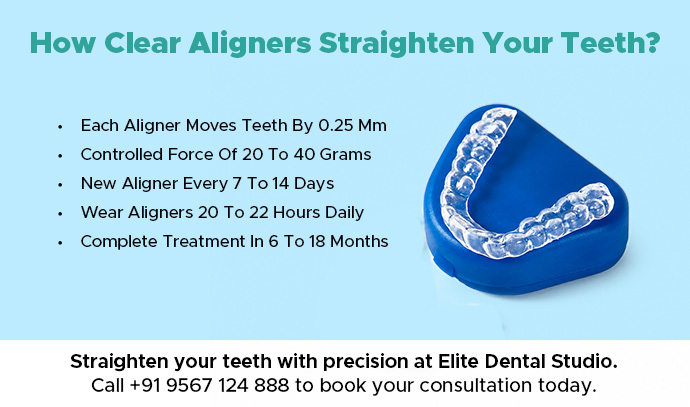
    Clear aligners move teeth by applying controlled pressure in small planned steps. Each aligner shifts teeth by about 0.25 mm to 0.3 mm per stage, which protects the tooth structure and keeps movement safe.

    When pressure applies to a tooth, the periodontal ligament reacts. One side compresses while the other stretches. This triggers bone remodeling around the tooth.

    The bone reshapes itself so the tooth can move into a new position. Each aligner continues this progressive movement.

    Aligners apply about 20 to 40 grams of force per tooth, which is enough to move teeth without wires or brackets. This is how aligners straighten your teeth in a controlled and predictable way.

    How Does Your Treatment Journey Progress From Scan To A Straight Smile?

    Your aligner journey follows a planned sequence from digital scan to final alignment.

    Digital Planning Creates Your Personalized Roadmap

    • 3D scan captures 6000+ data points
    • Each tooth position gets digitally mapped
    • Software builds a step-by-step movement plan
    • Treatment includes 15 to 40 aligners
    • Each stage predicts exact tooth movement

    Clear digital planning ensures accuracy before you even start wearing clear dental aligners.

    Sequential Trays Apply Calculated Pressure Every Two Weeks

    Each aligner differs slightly from the previous one by 0.25 mm to 0.3 mm, which creates movement.

    You wear each tray for about 7 to 14 days. The first 48 hours may feel slightly tight as pressure begins.

    • Initial tightness lasts around 48 hours
    • Teeth start adapting gradually after that
    • By day 10 teeth settle into position
    • Next aligner continues movement cycle

    Aligners must stay in your mouth for 20 to 22 hours daily. If you skip wear time, movement slows and treatment may extend. This directly affects dental aligners cost due to longer timelines.

    How Do Attachments Help Aligners Handle Complex Tooth Movements?

    Attachments help aligners perform precise movements that trays alone cannot achieve. These are small tooth-colored buttons placed on selected teeth.

    They usually measure 2 mm to 4 mm and improve grip between the aligner and tooth. Most cases need 6 to 12 attachments per arch depending on complexity.

    Attachments support movements like rotation, vertical adjustment and root positioning. They stay temporary and get removed after treatment completes.

    What Happens To Your Teeth Every Two Weeks?

    • Week 1 pressure activates bone cells
    • Day 3-4 ligament begins adjusting
    • Day 7-10 teeth settle into position
    • Week 2 ready for next 0.25 mm shift

    Experience precision tooth movement with clear aligner treatment in Calicut at Elite Dental. Book your 3D scan consultation today.

    Why Is Wearing Aligners 22 Hours Daily Important For Results?

    Aligners only work when they stay in your mouth long enough to apply constant pressure. If you wear them for 22 hours daily, you get about 330 hours of weekly force.

    If you wear them for only 15 hours daily, you get about 225 hours of force, which reduces effectiveness by nearly 30% to 40%.

    • Constant wear keeps movement active
    • Interrupted wear slows tooth response
    • Teeth lose movement momentum quickly
    • Restarting pressure delays progress
    • Treatment may extend beyond 18 months

    This is why clear dental aligners depend strongly on daily discipline.

    What Can Clear Aligners Fix And Where Do They Fall Short?

    Clear aligners can fix mild to moderate alignment issues with predictable results.

    They can treat

    • Crowding up to 6 mm
    • Spacing up to 5 mm
    • Overbite up to 4 mm
    • Crossbite affecting 2 to 4 teeth

    They may not suit

    • Severe skeletal jaw problems
    • Vertical movement above 3 mm
    • Rotations above 20 degrees
    • Cases needing jaw restructuring

    Understanding these limits helps you evaluate dental aligners cost based on realistic outcomes.

    Book An Appointment To Get Clear Aligner Results At Elite Dental Studio

    At Elite Dental Studio, we provide clear aligner treatment in Calicut along with services in Kannur and Kochi.

    We use in-house 3D scanning, which avoids delays from external labs and speeds up treatment start. Our orthodontic team has handled 200+ aligner cases, which helps manage both simple and complex treatments. Elite Dental Studio supports this journey with in-house 3D scanning, experienced orthodontists, treatment tracking and flexible follow-ups across Kannur, Kochi and Calicut.

    We also provide personalised treatment planning and virtual check-ins that reduce clinic visits. If you want a solution that fits your lifestyle and delivers visible results, aligners offer a strong option.

    Struggling with misaligned teeth? Get expert clear aligner treatment at Elite Dental Studio. Call +91 9567 124 888 today.

    FAQs

    Do aligners hurt when you start wearing them?

    You may feel mild pressure or tightness during the first 1–2 days as teeth begin shifting. This discomfort is temporary and usually reduces as your mouth adjusts to the aligners.

    Can I remove aligners anytime I want?

    You can remove them while eating, drinking, brushing, and flossing. However, they should be worn 20 to 22 hours daily to ensure proper and timely tooth movement.

    Will aligners affect my speech?

    You may notice a slight lisp or change in speech initially. Most people adapt within a few days as the tongue adjusts to the aligners.

    Can I switch to braces later if needed?

    Yes, switching to braces is possible if your case requires more precise control. Your dentist will recommend the best treatment based on your progress.

    Are aligners safe for long-term use?

    Yes, aligners are safe when used as directed by your dentist. Regular check-ups help monitor progress and ensure treatment stays on track.

  • How to Choose the Right Dental Clinic in Kannur for Your Family?

    To find the right dental clinic for your entire family, you need a place where your 5 year old feels comfortable, your teenager can get braces adjusted, and your aging parents receive implant consultations without visiting three different clinics across Kannur.

    The right dental clinic in Kannur offers comprehensive dental care, for all ages, under one roof, eliminating the hassle of coordinating multiple appointments at different locations. You need dental specialists who understand pediatric anxiety, orthodontic precision, and geriatric oral health challenges equally well.

    This blog is written by an expert dentist from Elite Dental Studio, a multi specialty clinic serving families across Kannur, Kochi, and Calicut. With board certified pedodontists, orthodontists, and oral surgeons available, we have helped over 3,500 families transition from dental clinic hopping to streamlined family care. Read further to know more about what a good dental clinic looks like.

    What Makes a Dental Clinic Truly Family Friendly in Kannur?

    A genuinely family friendly dental clinic in Kannur treats patients from age 3 to 83 with equal expertise, not just basic cleanings for everyone.

    • The clinic should have a pedodontist who uses behavior guidance techniques for anxious toddlers, an orthodontist who monitors your 12 year old’s developing bite, and an oral surgeon who can place implants for your 65 years old parent with diabetes and hypertension considerations.
    • Dental care, for all the ages, requires different communication styles on the same day. Your child needs simple explanations with visual aids, while your parent needs detailed medication interaction discussions before extraction. A truly family focused practice trains every team member in age appropriate communication, ensuring your nervous 7 year old doesn’t hear clinical terminology that triggers fear.
    • The physical environment reveals commitment to families. Look for separate waiting areas so toddlers playing don’t disturb adults reading, treatment rooms with ceiling mounted TVs for distraction during procedures, and wheelchair accessibility for elderly family members.

    The Non Negotiables When Evaluating Kannur Dental Clinics

    Having dental specialists in house eliminates the referral runaround that disturbs your family’s oral care. Here’s what you genuinely need under one roof:

    • Pedodontist for anxiety free children’s dentistry experiences.
    • Orthodontist to monitor growth from age 7.
    • Oral surgeon for wisdom teeth and implants.
    • Endodontist for root canals without external referrals.
    • Periodontist for gum disease in older adults.

    When your teenager needs orthodontic evaluation, the best dental clinic in Kannur schedules it immediately after their cleaning instead of giving you a referral slip to another clinic across town. This integration saves you three hours of travel and coordination time per family dental day.

    Without in house specialists, you face referral delays of 2 to 3 weeks for urgent orthodontic assessments. Your child’s tooth pain continues while you wait for the referred specialist to have availability, then you repeat medical history intake at the new clinic, and treatment timelines extend unnecessarily.

    Advanced Dental Technology That Reduces No. of Visits and Anxiety

    • Digital X rays reduce radiation by 80% exposure.
    • Safer for repeated child dental check up X rays.
    • Long term exposure risk significantly reduced over years.
    • Intraoral cameras show real time tooth condition visually.
    • Helps children understand cavities and treatment needs clearly.
    • Reduces fear through visual dental education approach.
    • 3D scanners replace messy impression trays completely.
    • Eliminates gag reflex caused by traditional impressions.
    • Fast 60 second scans improve patient comfort greatly.
    • Provides precise data for crowns and aligners.

    Intraoral cameras project live video on screens, helping children understand exactly what cavity the dentist in Kannur sees and why filling is necessary. This visual education reduces future resistance because kids comprehend the problem themselves rather than just hearing “you have a cavity.”

    Reading Between the Lines of Clinic Reviews and Credentials

    Online reviews need critical evaluation beyond star ratings. Look for specific details in feedback like “the pedodontist spent 15 minutes explaining crown procedure to my 8 year old using models” rather than generic “great experience.” Specific details indicate genuine patient experiences, while vague praise might be solicited reviews.

    dental clinic in Kannur


    Red flags in reviews include repeated mentions of “surprise costs” or “treatment plan changed multiple times.” These patterns suggest inconsistent diagnosis protocols or lack of upfront cost transparency. A quality dental clinic in Kannur provides itemised treatment plans with written cost estimates before starting any procedure beyond basic cleaning.

    Verify dentist credentials using their registration number. A Master of Dental Surgery (MDS) in specific specialties like Pedodontics or Orthodontics requires 3 additional years beyond the basic BDS degree. This specialisation matters significantly when treating complex cases in children or planning multi year orthodontic treatment.

    The clinic’s response quality reveals their patient care philosophy. Defensive answers or reluctance to discuss protocols before you visit indicates potential communication problems later when discussing treatment options for your family.

    Cost of Invisalign Clear Aligners in Kochi

    For specialised treatments like orthodontics, implants, or cosmetic procedures, driving 25 to 30 minutes to a superior facility makes financial and health sense. An improperly placed implant requiring removal and replacement costs ₹45,000 to ₹60,000 in corrective procedures, far exceeding any convenience savings from choosing the nearest clinic.

    Proximity matters most for three scenarios: pediatric dental emergencies, routine six month cleanings, and elderly patients with mobility limitations. A best dental clinic in Kannur located 10 minutes from your home means a knocked out tooth in your child’s cricket accident gets reimplanted within the critical 30 minute window that determines tooth survival.

    The Real Cost of “Affordable” Dental Care for Families

    The lowest priced filling might use older composite materials that stain within 18 to 24 months and require replacement, while premium composites maintain color stability for 5 to 7 years. You pay ₹1,200 three times in six years versus ₹2,500 once, ultimately spending ₹1,100 more for “affordable” care.

    Root canal retreatment becomes necessary in 15% to 20% of cases when the initial procedure lacks modern aids like apex locators or rotary instrumentation. The retreatment costs ₹8,000 to ₹12,000, requires crown removal and replacement for an additional ₹15,000, and subjects your family member to 3 to 4 extra dental visits with associated work time loss.

    Hidden costs accumulate when clinics don’t offer comprehensive services:

    Service Need Single Clinic Cost Multiple Clinics Cost
    Cleaning + orthodontic consult + wisdom tooth evaluation ₹2,500 (one visit, 90 minutes) ₹4,500 (three visits, 6 hours with travel)
    Child’s filling + parent’s crown prep + teen’s braces adjustment ₹8,500 (one morning, back to back slots) ₹9,800 (three half days off work, separate appointments)

    Factor in your hourly work rate and transportation costs. If you earn ₹500 per hour and spend 5 extra hours quarterly coordinating separate clinic visits, that’s ₹10,000 annually in lost productivity beyond the direct dental costs.

    Choose Elite Dental Studio for Integrated Family Care Across Kerala!

    Elite Dental Studio serves families across Kannur, Kochi, and Calicut with consistent specialist backed care and flexible scheduling designed for working parents. Our Kannur clinic houses five full time specialists and maintains a 68% patient retention rate over 4 years, treating three generations of 45 families.

    Call +91 9645874777 to schedule your family’s coordinated oral care assessment today.

    FAQs

    How do I know if a dental clinic in Kannur has good specialists or just general dentists claiming specialization?

    Check for their MDS degree in the relevant specialty and verify their Dental Council of India registration.

    Should I choose a clinic near my home even if reviews mention treatment quality concerns?

    A close clinic helps for routine care, but quality is more important. Poor treatment can lead to retreatment, increasing overall cost and time.

    What’s a reasonable timeframe to get specialist appointments for my family at a good dental clinic?
    Good clinics offer specialist consultations within 5–7 working days. Very long waits or instant availability for complex care may indicate staffing or quality concerns.

    How can I evaluate if a dentist is good with anxious children before my child’s first appointment?
    Ask for a short pre visit clinic tour to see how the dentist interacts with children. Good pediatric dentists explain tools and build comfort before treatment begins.

    Are family dental packages at Kannur clinics actually cost effective or just marketing tactics?
    Real packages offer clear savings of around 15 to 25% compared to individual pricing. If discounts are minimal, it is a marketing bundle with little real benefit.

  • Why Is It Important To Brush Your Teeth At Night?

    Skipping night brushing may feel harmless, especially when you feel tired after dinner. But overnight, saliva drops, bacteria feed on food residue and acid stays on your teeth for hours. That is why brushing before bed protects your enamel, gums and breath.

    The key benefits of brushing teeth at night include lower cavity risk, less plaque, fresher breath and better gum health. At Elite Dental Studio, we guide families across Kannur, Kochi and Calicut with preventive dental care, brushing demonstrations and child friendly oral hygiene education.

    Our dental clinics support more than routine checkups with expert dentists, modern dental technology and personalised risk assessment. This guide is written by an expert dentist from Elite Dental Studio to help you understand what happens inside your mouth at night.

    Read on to see how two minutes before sleep can save your smile from bigger problems and unnecessary dental care costs later too today.

    What Actually Happens In Your Mouth While You Sleep?

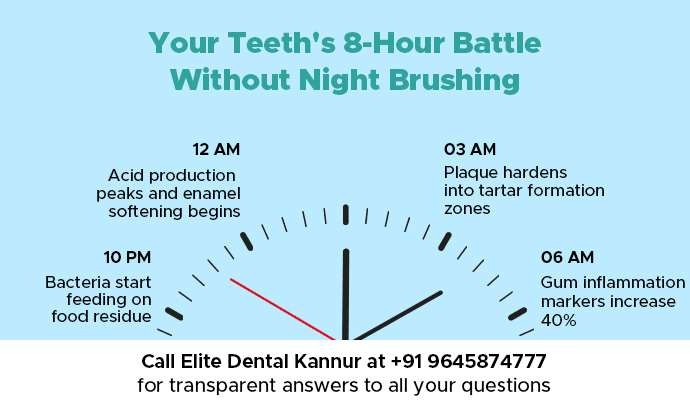
    • Your mouth loses much of its natural cleaning power while you sleep, so bacteria get more time to act on leftover food.
    • Saliva production drops by almost 90% at night. During the day, saliva washes food particles away and balances acid. At night, that protection slows down.
    • Bacterial growth also becomes more active because your mouth stays still for hours. Food residue breaks down and pH levels turn more acidic.
    • That acidic environment makes enamel vulnerable to decay.

    This is one of the strongest benefits of brushing teeth at night because brushing removes the fuel bacteria need before sleep.

    The 50% Cavity Reduction You Get From Two Minutes At Night

    Two minutes of night brushing can reduce cavity risk by nearly 50% because it removes daily plaque, sugary residue and food particles before bacteria produce acid.

    Your mouth carries more than 300 bacterial species. Some support oral balance, but harmful bacteria feed on leftover food and create acid.

    Morning brushing alone leaves your teeth exposed to nearly 8 hours of acid attacks every night. If you want guidance from a dental clinic in Kannur, preventive care should begin with this simple habit.

    dental clinic in calicut

    How Plaque Becomes Your Enemy After 24 Hours?

    Plaque can change from a soft sticky film into hardened tartar within 24 to 48 hours, especially when you skip night brushing often.

    From Soft Film To Rock-Hard Tartar Overnight

    • Plaque forms after meals and snacks.
    • Night brushing removes soft bacterial film.
    • Leftover plaque hardens within 24 hours.
    • Tartar needs professional scaling for removal.
    • Home brushing cannot remove hardened calculus.
    • Poor brushing may need three-month scaling.
    • Better hygiene supports six-month cleaning visits.

    A dental clinic in Kochi can remove tartar with professional scaling. But once plaque hardens, your brush cannot fix it at home.

    The Gum Disease Chain Reaction Starting Tonight

    Overnight plaque can irritate your gums quickly. Bleeding may start within 48 hours of skipped brushing, especially when plaque sits near the gumline.

    Inflammation markers rise as bacteria collect. You may notice swollen gums, bleeding gums, bad taste or tenderness while brushing.

    Chronic nighttime neglect can affect deeper support over time. Bone loss may begin within 6 months of ongoing gum inflammation. A best dentist in Kochi can treat gum disease, but early prevention protects your gums better.

    Bad Breath Is Just One Visible Symptom | There’s More To Worry About

    Morning bad breath often signals overnight bacterial overgrowth, but the smell is only the first warning.

    Bacteria release odor-causing compounds when they break down trapped food particles. These compounds create the stale breath many people notice after waking up.

    The bigger problem stays invisible. Acid can start enamel demineralization. Early cavity formation can begin before pain appears. Gum pockets can also deepen if plaque keeps collecting.

    If bad breath returns daily, visit a dental clinic in Calicut for a checkup. Night brushing helps control odor and reduces the bacterial load behind it.

    The Right Way To Brush Before Bed For Maximum Protection

    Night brushing works best when you brush at the right time, use the right toothpaste and follow the right technique.

    • Brush for full two minutes nightly.
    • Use fluoride toothpaste above 1400 ppm.
    • Wait 30 minutes after acidic foods.
    • Brush right before going to sleep.
    • Avoid heavy rinsing after brushing.
    • Let fluoride protect enamel overnight.
    • Hold brush at 45 degrees.
    • Angle bristles toward gumline gently.
    • Use small circles near gums.
    • Clean outer, inner and chewing surfaces.

    The modified Bass technique helps protect the gumline. Hold the brush at a 45-degree angle toward your gums and move it in small circles.

    This method clears food residues, protects enamel and gives maximum protection before sleep.

    Consult Dental Experts At Elite Dental To Learn Prevention That Saves You Thousands

    Elite Dental Studio helps you prevent cavities, plaque buildup and gum disease with practical oral hygiene guidance across Kannur, Kochi and Calicut.

    If you need a dental clinic in Kannur, our team can guide your family on night brushing, fluoride use and routine dental checks. If you want a dental clinic in Kochi, we also offer brushing technique demonstrations and preventive assessments. We support children with oral hygiene education and help working professionals with evening appointment options. These visits help you catch plaque, gum inflammation and early decay before they turn into expensive treatment.

    Our team also offers personalised cavity risk checks, gum health evaluation and evening appointment support for busy patients in Kannur, Kochi and Calicut.

    Skipping night brushing too often? Learn prevention that protects your teeth at Elite Dental Studio. Call +91 9567 124 888 today.

    FAQs

    Should I brush before or after flossing at night?
    Floss first, then brush your teeth. This removes trapped food and plaque, allowing fluoride from toothpaste to reach between teeth more effectively.

    Can mouthwash replace night brushing?

    No, mouthwash cannot remove sticky plaque from tooth surfaces. It can support oral hygiene, but brushing is essential for proper cleaning at night.

    Should children brush at night too?

    Yes, children should brush every night before bed. Parents should supervise or assist until the child can brush thoroughly on their own.

    Why do my gums bleed during night brushing?

    Bleeding gums often indicate plaque buildup or early gum issues. If it continues for several days, you should visit a dentist for evaluation.

    Can I eat after brushing at night?

    It is best not to eat after brushing at night. Eating leaves food particles in the mouth, increasing the risk of decay while you sleep.

  • Best Maxillofacial Surgeon In Kerala

    Jaw pain, facial swelling, trauma after an incident, or a difficult wisdom tooth can quickly stop feeling like a routine dental problem. In such situations, don’t just look for a treatment, but also the right surgeon, the right diagnosis, and a plan that you can trust from the beginning.

    The best maxillofacial surgeon in Kerala, is one with proper oral and maxillofacial surgery training, proven experience, scan-led planning, and a clear recovery plan.

    At Elite Dental Studio, patients can access maxillofacial and orthognathic surgery support across Calicut, Kochi, and Kannur, with consultants such as Prof (Dr). Padmaraj Hegde and Dr. Ajun Suri. The right specialist provides proper oral and maxillofacial surgery training, experience with cases like yours, scan-led planning, and a clear recovery pathway after the procedure.

    This blog will help you understand what to check in the surgeon, the best dental clinic in Calicut setup, and the follow-up system before making your decision.

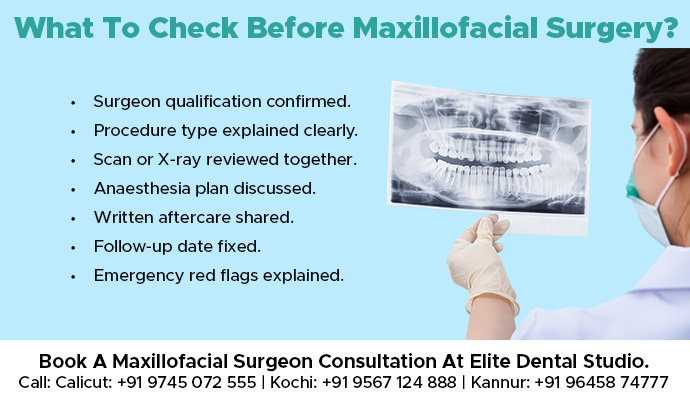
    What Qualities Should You Look For In The Best Maxillofacial Surgeon?

    Choose a maxillofacial surgeon based on specialist training, relevant case experience, scan-led planning, and clear safety and follow-ups.

      • Look for an oral and maxillofacial surgery specialist : A maxillofacial surgeon treats conditions involving the jaw, face, and oral structures. This needs specialist surgical training.
      • Case Experience that fits your problem: A maxillofacial surgeon in Kerala might do many kinds of procedures. Ask which bucket your case falls into:
        • Jaw fractures and facial trauma.
        • Jaw alignment correction and orthognathic surgery.
        • Impacted wisdom tooth and surgical extractions.
        • TMJ issues and jaw locking evaluation.
        • Cysts, growths, biopsy guidance, and surgical management.
      • Planning and communication that prevents surprises: The best dental clinic in Calicut, starts before the surgery day. In your consultation, the surgeon should explain what they think the diagnosis is. Show you what they see on your scan or X-ray. And tell you what recovery will look like.
      • Safety Mindset You Can See: You can feel this within minutes, just check how the team checks your medical history, current medicines and give written aftercare instructions.
    What To Check What A Good Surgeon Does
    Qualification Shows OMFS training clearly
    Case fit Has experience in your procedure type
    Planning Uses scans and explains findings
    Consent Explains risks and recovery in plain words
    Aftercare Gives written rules and follow-up plan

    What Should A Good Maxillofacial Surgery Setup Include?

    A good setup for maxillofacial surgery includes correct imaging, sterile protocols, the right team support, and a structured aftercare pathway. Even the best dental clinic in Kochi or the best dental clinic in Kannur needs the right setup to deliver safe care.

    Correct Diagnosis And Imaging

    Some cases need only an X-ray. Some need a 3D scan. A good clinic uses imaging when it changes the plan or case is complex.

    Procedure Pathway That Is Not Rushed

    A clear surgical pathway feels calm and predictable. It usually includes:

        • Pre-op checks and medical history review.
        • Clear explanation of anaesthesia type and what you will feel.
        • Time estimates that match reality.
        • Written do’s and don’ts for the first 24 to 72 hours.

    Aftercare That Prevents Complications

    Aftercare is part of the treatment. It is not an optional add-on. A strong setup gives you:

        • A swelling and pain plan.
        • Food rules that match your type.
        • Oral hygiene rules .
        • A follow-up schedule.
        • A direct contact route if a problem occurs.

    best maxillofacial surgeon in kerala

    Book A Maxillofacial Surgeon Consultation At Elite Dental Studio In Kerala

    When a case involves the jaw, facial bones, impacted teeth, or surgical planning, the quality of the consultation matters along with the procedure. Most patients feel confident when the surgeon explains the diagnosis clearly, reviews the scan properly, and gives a recovery plan that feels structured instead of rushed.

    Elite Dental Studio offers maxillofacial and orthognathic surgery support through listed OMFS consultants, modern diagnostic planning, and a clinical pathway built around safety, comfort, and follow-up. With access to 3 cities, patients can choose the best dental clinic in Kochi or the best dental clinic in Kannur. If you want a clearer evaluation and a specialist-led treatment plan, call Elite Dental Studio:

    Calicut: +91 9745 072 555 | Kochi: +91 9567 124 888 | Kannur: +91 96458 74777

    Frequently Asked Questions 

    How Do I Know If I Need A Maxillofacial Surgeon Or A Regular Dentist?

    If your issue involves jaw bone, facial swelling, complex impacted teeth, or jaw alignment, you need a maxillofacial surgeon. If it is a routine cavity or cleaning, a general dentist can help.

    Is Wisdom Tooth Surgery Always Done By A Maxillofacial Surgeon?

    Simple extractions can be done by dentists, but impacted or difficult wisdom teeth need a maxillofacial surgeon because the tooth position and nearby nerves need careful planning.

    What Scans Are Needed Before Maxillofacial Surgery?

    Many maxillofacial cases start with a clinical exam and a dental X-ray. A 3D scan may be needed for complex impactions, jaw surgery planning, or when the anatomy is not clear on an X-ray.

    How Long Does Recovery Take After Common Maxillofacial Procedures?

    Recovery depends on the procedure. Minor surgical extractions can take a few days for discomfort to settle, while jaw surgery or trauma care needs a longer recovery plan with after surgery follow-ups.

    When Should I Treat Jaw Pain Or Facial Swelling As Urgent?

    If you have fast-increasing swelling, fever, trouble opening your mouth, or difficulty breathing, treat it as urgent and seek immediate care. Do not wait at home.

    What Questions Should I Ask In The First Consultation?

    In your first consultation with a maxillofacial surgeon ask what the diagnosis is, what procedure is advised, why it is needed, what scans are required, what risks to watch for, and what follow-up schedule will be followed.

  • Why Do My Teeth Hurt When I Have A Cold? Causes & Relief Explained

    A cold can block your nose, your head feels heavy, and teeth start aching. For some people, it also brings an aching feeling in the teeth, especially the upper back teeth. That is when many patients end up asking: why do my teeth hurt when I have a cold?

    The reason is sinus pressure. The upper back teeth sit close to the sinuses, so inflammation and congestion can create a dull, spreading ache that feels like tooth pain. At the same time, a cold can also make an existing dental issue feel more noticeable.

    At Elite Dental Studio, patients can get a clearer dental evaluation when tooth pain feels confusing or does not settle as expected. They help decide whether the cause is sinus-related or not, and guide the right next step.

    This blog breaks down the common reasons, the safest relief steps you can do today, and a simple way to decide when you should get a dental check at the best dental clinic in Calicut.

    Why Do Teeth Hurt During A Cold ?

    Teeth can hurt during a cold because sinus inflammation and pressure can trigger referred pain, and being sick can also worsen existing tooth sensitivity. Your upper back teeth and sinuses live close to each other. When your sinuses swell and fill with pressure, your brain can read that pressure as tooth pain. That is why the ache feels “all over” the upper teeth instead of one single tooth.

    A cold can also change your habits. You mouth-breathe. You drink less water. Your mouth dries out. That dryness can make sensitive teeth feel worse for a few days.

    The Most Common Causes of Teeth Pain In Cold

    The most common teeth pain causes are sinus pressure, congestion-related mouth breathing, clenching, and sensitivity from existing dental issues.

    Mouth Breathing And Dry Mouth

    When your nose blocks, you breathe through your mouth. Thus, dry air and lower saliva can increase sensitivity. That is why brushing can sting more when you are sick.

    Clenching Or Grinding When You Feel Unwell

    Some people clench more during sleep when they feel congested or stressed. Elite Dental Studio also discusses winter-related tooth pain and lists factors like sinus issues and grinding as contributors.

    A Hidden Dental Issue That Becomes Obvious

    A cold does not cause cavities, but it can make you notice a deep filling that starts leaking, or a cracked tooth that reacts to pressure.

    If you keep thinking about the best dental clinic in Kochi for a quick check, this is one of the big reasons to book. You want to rule out a real tooth problem before you assume it is only sinus pressure.

    sinus tooth pain vs dental tooth pain

    How Do You Know If It Is Sinus Tooth Pain Or A Real Tooth Problem?

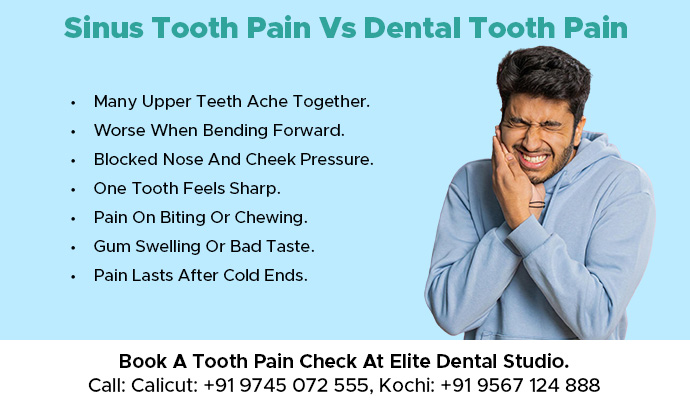
    Sinus tooth pain feels like a dull ache across several upper teeth, while a true tooth problem feels sharp and focused on one tooth. Here is an easy self-check you can do at home.

    Signs It Is More Likely Sinus-Related

    • The ache affects multiple upper teeth.
    • You feel cheek pressure and blocked nose at the same time.
    • Pain feels worse when you bend forward or move your head.
    • The pain improves as congestion improves.

    Signs It Is More Likely Dental

    • One tooth hurts more than the others.
    • Pain increases when you bite or chew on that tooth.
    • You get sharp sensitivity to hot or cold.
    • You notice gum swelling, a bad taste, or a pimple-like bump on the gum.

    If you are unsure, do not force a diagnosis at home. A simple exam and X-ray can settle it quickly. That is where the best dentist in Kochi or a local clinic can help you avoid days of guessing.

    What Can You Do Today For Quick Relief?

    You can reduce sinus pressure, protect sensitive teeth, and calm inflammation with a few safe steps while your cold settles. These steps are safe for most people.

    Step 1: Reduce Sinus Pressure

    • Use steam inhalation or a warm shower to loosen congestion.
    • Use saline nasal rinse if it suits you.
    • Rest with your head slightly elevated.

    Step 2: Stay Hydrated

    • Sip warm fluids through the day.
    • Avoid too much caffeine if it dries you out.
    • Hydration helps saliva do its job.

    Step 3: Eat And Drink Gently

    • Avoid extreme hot or cold foods if teeth feel sensitive.
    • Stick to softer foods if chewing triggers pain.

    Step 4: Keep Brushing, But Do It Gently

    • Use a soft brush.
    • Brush slowly.
    • Do not scrub hard thinking it will “clean better.”

    Step 5: Use Basic Pain Relief If Needed

    Use over-the-counter pain relief as appropriate for you. If you have medical conditions, follow your physician’s advice.

    If these steps reduce pain within a day or two, it points toward sinus-related discomfort. If pain keeps rising, you should not wait too long and book the best dental clinic in Calicut.

    What Daily Management Helps Until The Cold Clears?

    Daily management is about letting the cold settle while preventing dryness, sensitivity, and pressure from building up again. Patients love a simple routine, so here is the suggestion:

    Morning

    • Warm water or warm tea.
    • Gentle brushing and rinse.
    • Steam once if congestion is heavy.

    Afternoon

    • Hydrate regularly.
    • Avoid snacking all day.

    Night

    • Brush gently before going to bed.
    • Keep a humidifier.
    • Sleep with an elevated head if sinus pressure is heavy.

    This routine cannot fix a cavity or an abscess, but it will reduce cold-related discomfort.

    When Should You Stop Waiting And See A Dentist?

    You should see the best dentist in Kochi if tooth pain is severe, one-sided, lasts beyond the cold, or comes with swelling or a bad taste. Use these red flags to make a decision:

    • Pain lasts more than 7- 10 days.
    • Pain focuses on a single tooth.
    • Gum swelling or pus.
    • Night tooth pain.
    • Pain returns every time you catch a cold.

    What Will A Dentist Check For Cold-Related Tooth Pain?

    A dentist checks your teeth, gums, bites, and takes an X-ray when needed to confirm whether your pain is sinus-related or dental. This is what a proper visit includes:

    • Tapping and pressure tests to find the exact tooth.
    • Gum check for swelling and infection signs.
    • Sensitivity checks if needed.
    • X-ray to rule out deep decay, cracks, or infection.

    This is the most direct way to answer why do my teeth hurt when i have a cold as many people assume it is sinus pain, then later discover a cracked filling or deep cavity. An exam removes that uncertainty.

    Book A Tooth Pain Check At Elite Dental Studio In Calicut Or Kochi

    Tooth pain during a cold is not always a cavity, but it should not be dismissed either. When the pain spreads across several upper teeth, it may be linked to sinus pressure. But when one tooth hurts more, chewing becomes painful, or the discomfort continues even after the cold improves, the cause may be dental and worth checking properly.

    At Elite Dental Studio, a dental exam can help confirm whether the pain is sinus-related or coming from a tooth, gum, crack, or existing restoration. With access to comprehensive dental care in Calicut and Kochi, patients can get a clearer diagnosis and the right next step without having to keep guessing at home. To book a tooth pain consultation at the best dental clinic in Kochi, call:

    Calicut: +91 9745 072 555
    Kochi: +91 9567 124 888

    FAQs

    Can A Cold Cause Tooth Pain Even If I Have No Cavities?

    Yes. Sinus inflammation can refer to pain in the upper back teeth, and congestion can increase sensitivity.

    Why Do My Upper Back Teeth Hurt More Than The Front Teeth?

    Upper back teeth sit closer to the sinuses. Sinusitis can commonly cause pain in those upper rear teeth.

    How Long Should Cold-Related Tooth Pain Last?

    If it is sinus-related, it often improves as congestion improves. If pain lasts beyond 7 to 10 days or worsens, get a dental check.

    What If Only One Tooth Hurts During My Cold?

    One-tooth pain can point to a dental issue like decay, a crack, or gum infection. Book an exam to rule that out.

  • How Can Salt Help Keep Dental Problems Away? Breaking Down The Claims.

    DIY home remedies have made salt water sound like a full fix for dental problems. When your gums feel sore or mouth tastes odd, it is tempting to rinse and move on. Many people do that, but feel shocked when bleeding, sensitivity, or swelling continues.

    Salt supports oral comfort and basic hygiene but as a short-term habit, and cannot replace brushing, flossing, or dental treatment. Elite Dental Studio suggests salt-water rinses as supportive care, but not as a primary treatment.

    If you want a safe dental plan in Kannur, Elite Dental Studio offers gum checks, professional cleaning, cavity evaluation, and pain assessment using top-class advancements and modern pain-management technology. In this guide, you will discover the truth how salt keep dental problems away, what it helps, what it cannot fix, how to rinse safely, and when to see a dentist.

    Does Salt Help With Dental Problems Or Is It Just A Myth?

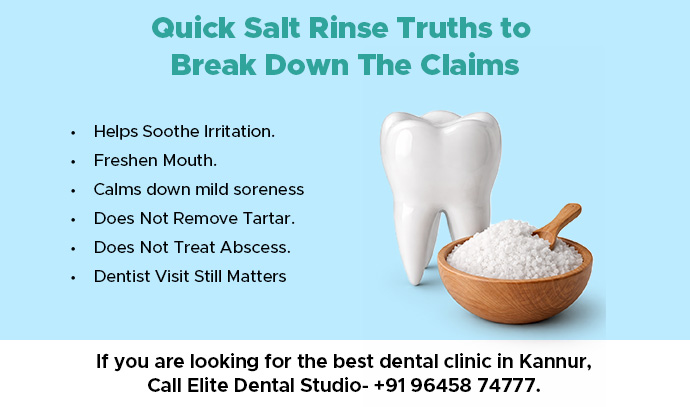
    Salt can help with short-term soothing and hygiene support, but it does not remove plaque or treat cavities. When people say salt helps dental problems they mean:

    • The gums feel less irritated for a while.
    • The mouth feels fresher.
    • Mild soreness feels calmer after rinsing.

    That is real, and it is why salt water keeps showing up in home advice. The myth starts when relief gets mistaken for a cure by the best dental clinic in Kannur. A rinse can reduce irritation, but it cannot remove hardened tartar, or fill a cavity.

    What Dental Problems Can Salt Help With?

    Salt-water rinses help soothe inflamed gums, minor mouth sores, and irritation, especially as a short-term routine. It works best as a helper, not as a main treatment. Here are situations where it can make sense.

    Gum Irritation And Mild Swelling

    If your gums feel a bit puffy or tender, a warm salt-water rinse can feel soothing. Some dental clinic in Kannur also suggest salt rinses have anti-inflammatory effects in certain gum healing contexts. This does not remove tartar, but it can reduce discomfort while you plan proper cleaning.

    Mouth Ulcers And Small Cuts

    If you accidentally bite your cheek or get a small sore, a gentle rinse can keep the area cleaner and reduce irritation.

    Braces Soreness

    When braces or aligners rub the cheeks, salt water can calm the tissue. It is not a fix for sharp edges, but it helps you get through the first few days.

    After-Food Irritation And Bad Taste

    After spicy or very sticky foods, rinsing can wash away residue and make your mouth feel fresher. After trying home rinses for a week many people search for the dentist in Kannur as the real issue did not go away.

    What Can Salt Not Fix, Even If It Feels Better?

    Salt cannot remove plaque or tartar, reverse cavities, or treat abscess infections. Pain can be reduced even when the cause stays. For example, a cavity can stop hurting for a few days, then come back worse. Salt water may calm the area, but it does not repair the tooth.

    Tartar is a hardened plaque. You cannot rinse it away, even with strong salt water. You need professional cleaning to remove it safely.

    Why Cavities Need Treatment? 

    A cavity is tooth damaged. It needs a filling or other treatment by the best dental clinic in Kannur. to stop it from progressing. Rinses cannot rebuild the lost structure.

    Why Does Abscess Needs Dental Care?

    An abscess is an infection pocket. Rinsing might reduce bad taste for a while, but it will not remove the infection source. If you keep rinsing and the issue keeps returning, that is your sign to book a check at a dental clinic in Kannur and get the real diagnosis.

    How To Use A Salt-Water Rinse Safely?

    Use mild warm salt water, swish gently, and avoid overuse or strong concentration that can irritate tissues. Discover the truth how salt keep dental problems away as a lot of people go wrong here by making it too salty. Strong mixes can sting and irritate the mouth.

    Simple Steps to Use Salt Water

    • Mix half a teaspoon of salt in a glass of warm water.
    • Swish gently for 20 to 30 seconds, then spit it out.
    • For short-term comfort, 2 to 3 times a day is enough for a few days.
    • Do not make it an all-day habit for weeks.

    Who Should Be Careful?

    • People with dry mouths who already feel burning.
    • People with ulcers that sting badly.
    • Kids who might swallow the rinse.
    • Anyone with high blood pressure who is advised to limit salt intake

    Is Salt Better Than Mouthwash For Daily Use?

    Salt-water can be a gentle option for short-term soothing, while mouthwash choice depends on your condition and dentist advice. Salt water and mouthwash do different jobs. Salt water mainly helps with comfort and gentle cleansing. Some mouthwashes target plaque bacteria and gum inflammation more directly.

    Option What It Helps With? What It Cannot Replace?
    Salt-Water Rinse Short-term soothing, freshness Brushing, flossing, scaling
    Dentist-Advised Mouthwash Gum inflammation control in specific cases Cleaning between teeth, cavity treatment


    Precautions And Risk Involved In Salt Use

    Salt rinses are safe for most people when mild and short-term, but strong mixes and daily overuse can irritate the mouth. Keep these precautions in mind:

    • Do not use very strong salt water, it can burn tissues and worsen ulcers.
    • Do not scrub teeth with salt. It can scratch surfaces and irritate gums.
    • Do not use salt water to delay treatment for swelling, pus, or toothache.
    • Do not let kids rinse without supervision.

    Salt water is a helper habit. It should never become the reason you postpone treatment.

    When Should You Stop Home Remedies And See A Dentist?

    See a dentist if pain, swelling, bleeding, bad breath, or ulcers keep returning or last beyond 10 to 14 days. Here are the red flags that mean you should stop experimenting and get checked:

    • Severe toothache
    • Swelling on the face or gums.
    • Bleeding gums daily.
    • Loose tooth feeling or tenderness while chewing.
    • Ulcers that stay more than two weeks.

    At this stage, home rinses can waste time. The fastest way forward is a proper exam, an X-ray if needed, and a clear plan.

    Book Elite Dental Studio In Kannur For Gum And Tooth Checks

    If salt rinses are not enough, Elite Dental Studio can identify the real cause and give a treatment plan that prevents repeat problems.

    When patients come in after trying salt water for days, they want two things. A real diagnosis and a simple plan. Elite Dental Studio offers a complete top-class armamentarium and modern pain-management technology to keep care comfortable.

    Book an evaluation, Call: +91 96458 74777.

    FAQs

    Does salt-water rinse remove plaque?

    Salt water rinse can wash away debris and soothe your gums, but it does not remove plaque.

    Can salt cure gum disease?

    Salt water reduces irritation for short-term, but gum disease involves tartar that needs professional cleaning.

    How often can I rinse with salt water safely?

    Most people can use a mild rinse 2 to 3 times a day for a few days. Avoid long-term daily use unless your dentist advises it.

    Can kids use salt-water rinse?

    Older kids who can spit properly can use a mild rinse under parents supervision. Avoid it for toddlers.

    Can I replace toothpaste with salt?

    Toothpaste with fluoride supports enamel and cavity protection, which salt does not do.

  • Can a Tooth Abscess be Treated with Just Antibiotics?

    Antibiotics reduce swelling and pain, but they cannot cure a tooth abscess because they do not remove the source of infection.  To stop tooth abscess from coming back, a dentist needs to treat the cause.

    Tooth abscess pain feels sharp, deep, and impossible to ignore. It is an infection trapped inside the tooth or under the gums. A dentist in Calicut, at Elite Dental Studio is a good choice to treat tooth abscess because they focus on comfort-led care and have multi-specialty support when a case needs endodontics, surgery, or gum care.

    If you are researching  tooth abscess – diagnosis & treatment, this blog gives you when antibiotics help, why they fail, how dentists confirm the source, and when swelling becomes urgent. 

    Can Antibiotics Treat Tooth Abscess Alone ?

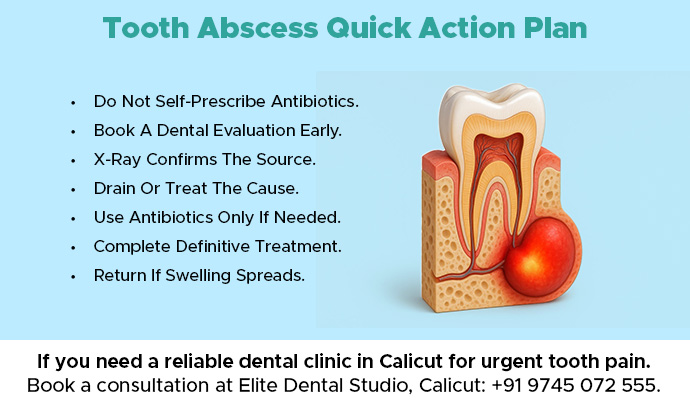
    Most of the time, antibiotics reduce swelling, and  do not remove the infected tissue or drain the abscess, so the problem returns. Antibiotics can lower the heat but they do not remove the fuel. This fuel is trapped infection.

    Why Antibiotics Reduce Swelling But Do Not Remove The Cause?

    A tooth abscess is often a closed-space infection. A tablet cannot physically empty that space. Antibiotics are not capable enough to drain pus under pressure, remove dead nerve tissue from inside the tooth or clean the root canal space and seal it. So yes, you may feel better. But the source can stay.

    When Antibiotics Help And When They Do Not?

    Antibiotics are more useful when you have fever, swelling is spreading beyond the tooth area or immediate dental treatment at the best dental clinic in Calicut is not possible.

    Antibiotics are usually not the main solution when:

    • The pain is from an infected tooth nerve.
    • There is a clear pus pocket that needs drainage.
    • A gum infection needs deep cleaning.

    If you keep taking tablets and delaying the real treatment, you may end up with a bigger flare-up and fewer options.

    tooth abscess quick action plan

    Which Antibiotics Are Used For A Tooth Abscess And When?

    A dental clinic in Calicut may prescribe antibiotics when there are systemic signs or when definitive treatment is delayed, but the choice depends on your exam and medical history. Antibiotics support the plan in selected cases. They do not replace drainage, root canal treatment, or gum treatment when those are needed.

    Common Antibiotics Used

    • Amoxicillin: Used for  many dental infections.
    • Clindamycin: Commonly used as an alternative for patients with penicillin allergy.
    • Metronidazole: Added with amoxicillin or penicillin in more severe infections where anaerobic bacteria are suspected.
    • Azithromycin: Another alternative option in certain cases, when allergies limit choices.
    • Co-amoxiclav (Amoxicillin and Clavulanic acid): Sometimes used when broader coverage is needed based on clinical judgement.

    Why Does A Tooth Abscess Come Back After Antibiotics?

    Tooth Abscess comes back because antibiotics can calm the inflammation, but bacteria can remain protected where they need physical cleaning, drainage, and sealing. Dental bacteria often live in a sticky layer that clings to tooth structure. Inside a tooth, infection can sit in tiny canals. Under the gum, it can sit in deep pockets. A tablet cannot scrub those surfaces clean.

    Think of it like grime stuck in a narrow pipe. You can pour something over it and feel a little improvement, but the grime still sticks until the pipe is cleaned properly.

    How Do Dentists Diagnose A Tooth Abscess?

    A  dentist in Calicut, diagnoses a tooth abscess by combining your symptoms with clinical tests and imaging to find the real source and choose the right treatment. A good diagnosis is what stops repeat flare-ups. A dentist typically checks:

    • Which tooth hurts on tapping or biting?
    • Whether there is gum swelling, drainage, or a gum boil?
    • How does the tooth respond to simple tests, if needed?

    X-Ray, What It Shows And Misses?

    X-rays at the best dental clinic in Calicut can show deep decay, bone changes, and infection patterns. Early infection can sometimes look subtle, so match the X-ray with your symptoms.

    CBCT

    A CBCT scan is not needed for every case. It can help when root anatomy is complex, symptoms do not match the regular X-ray or when a clearer map is needed by the dental clinic in Calicut before planning treatment.

    How Dentists Tell Tooth Abscess Vs Gum Abscess?

    A tooth abscess links to the nerve and root tip area. A gum abscess links to gum pockets and gum disease. The treatment plan changes depending on which one it is. If you searched for tooth abscess – diagnosis & treatment, proper diagnosis saves time and pain.

    When Does A Tooth Abscess Become A Medical Emergency?

    Tooth abscess  becomes a medical emergency when infection affects breathing, swallowing, or spreads rapidly with fever and facial swelling. Please do not wait at home if you notice:

    • Difficulty breathing or swallowing.
    • Rapidly increasing facial swelling.
    • High fever, chills, or feeling faint.
    • Trouble opening the mouth.
    • Swelling spreads toward the jaw or neck.

    In these situations, seek urgent medical care first. After you are stable, dental treatment is still needed to remove the infection source.

    Tooth Abscess Diagnosis And Treatment At Elite Dental Studio, Calicut

    If antibiotics are not enough, Elite Dental Studio in Calicut can identify the source and provide definitive treatment so the abscess does not keep returning. You get endodontics care if the tooth can be saved with root canal treatment. Surgical care if drainage or extraction is needed. And gum care if the abscess is linked to periodontal infection.

    Book A Consultation Call Elite Dental Studio, Calicut: +91 9745 072 555.

    FAQs

    Will It Go Away On Its Own?

    The pain may reduce if it drains, but the infection source often remains and can flare again. Thus, definitive treatment prevents repeats.

    How Long Can I Wait?

    Do not wait if pain and swelling are present. Early care reduces spread risk and often makes treatment simpler. If fever or facial swelling starts, treat it as urgent.

    Can The Tooth Be Saved?

    Often yes. Root canal treatment can save a tooth when enough structure remains. The dentist confirms this after an exam and imaging.

    Can Kids Get Abscesses?

    Yes. Deep cavities or trauma can cause abscesses in children too. Early evaluation matters to protect the developing mouth.

    Does A Root Canal Hurt?

    With proper numbing, most people feel pressure, not pain. Mild soreness after treatment can happen for a short time, especially if swelling was present.